Table of Contents
ToggleSince the start of the year 2025, once the trump administration took charge, the dynamic of U.S immigration is shifting constantly, with significant updates in non-immigration and immigration visa policies changing throughout 2025. One of the most talked about changes was changes in the existing 3rd country stamping facility, where individuals sought faster appointments abroad.
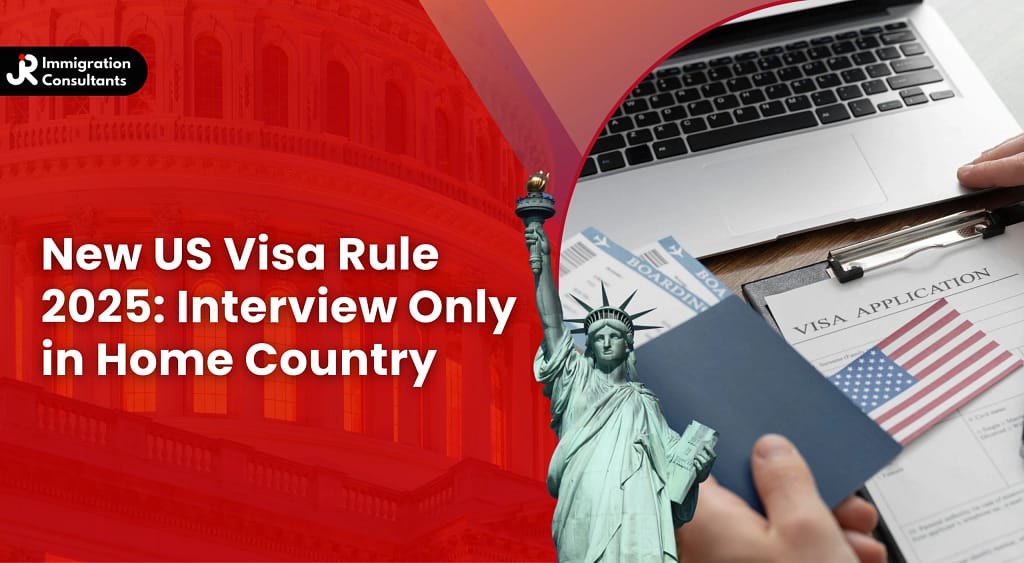
Now replaced with a mandatory requirement that visa interviews must occur exclusively in the applicant’s country of nationality or residence. Or in simple layman’s terms, we can say now one can only apply for a U.S visa in the home country only.
U.S visa Interview 2025, rules, announced by the U.S. Department of State (DOS), this rule aims to enhance national security, reduce fraud, and streamline consular operations. However, it has sparked concerns over extended wait times, increased costs, and disruptions for global travellers, workers, and families.
As of November 27, 2025, these policies are fully in force, affecting millions of applicants worldwide. Whether you’re a student eyeing an F-1 visa, a professional renewing an H-1B, or a family pursuing immigrant visas, or a student applying for visa interview, understanding these rules is crucial to avoid delays or denials. This guide breaks down the key changes, eligibility, impacts, and practical steps, drawing from official DOS announcements and expert analyses.
Background: Why the Shift to Home-Country Interviews?
Earlier, applicants had an option to opt for U.S visa interviews at any U.S embassy or consulate with available slots. Countries like Mexico, Canada, and Thailand were used y nations like India, China, or any developing African nation because of their higher U.S visa demands.
This option of “3rd country stamping”, though, was more convenient for high-demand nations to bypass the longer waiting visa approval time in their home country, but this also raised possible security concerns about inadequate evaluation of visa applications.
So, to curb all these loopholes, the trump administration’s immigration agenda was laid, where focus was on stricter enforcement, prompting DOS to have more stringent controls.
This important announcement came on September 6, 2025, for non-immigrant visa applicants mandating interviews in the applicant’s country of nationality or residence. A parallel rule for immigrant visas (IVs) took effect on November 1, 2025, requiring interviews in the consular district of residence or, upon request, the country of nationality.
These changes build on earlier 2025 updates, including a February narrowing of interview waivers to 12 months from expiration and a July expansion of limited waivers, only to reverse course in September by largely eliminating them.
Here’s a detailed overview of the new 2025 U.S. Department of State (DOS) visa-policy change — what it means, who it affects, and what applicants must know if they plan to apply for a U.S. visa now.
What’s the new rule?
- As of 6 September 2025, DOS has ended the practice of “third-country visa stamping” / “third-country nonimmigrant visa processing (TCN)”.
- Under the new rule, all non-immigrant visa (NIV) applicants must schedule and attend their consular interview at a U.S. Embassy or Consulate in either:
- Their country of nationality (citizenship)
- Their country of legal residence (if they live outside their home country).
- In countries where the U.S. does not maintain routine visa operations, DOS may designate an alternate embassy/consulate to handle interviews for those nationals.
Who is affected?
This rule broadly affects most categories of U.S. non-immigrant visas, such as:
- Student visas (e.g., F-1)
- Work visas (e.g., H-1B, O-1, etc.)
- Visitor / Business visas (B-1, B-2, B-1/B-2)
- Other non-immigrant categories (M, J, etc.)
This means under the new visa interview policy of USA, if you are currently living abroad but are a citizen of another country, you cannot simply go to the U.S. Embassy in your country of temporary residence (or a “third country”) for visa stamping — you must go to your home country (or legal residence country) for the interview.
Exceptions — When third-country processing might still work
There are very limited exceptions:
- Nationals from countries where the U.S. doesn’t run routine visa operations — for these, DOS has specified designated alternative posts.
- Diplomatic, official, U.S. government-related, or certain international organization visas (e.g., A, G, C-2/C-3, UN-related visas) may not be covered by this rule.
But for most regular student, visitor, or work visas, you should assume the new “home-country / residence-country only” rule applies.
Why did DOS change the rule?
Based on the official update, DOS and U.S. immigration stakeholders invoke a few reasons:
- Increased standardization of visa processing and fraud prevention — by ensuring applicants are interviewed in their home or residence country, background verification and residency checks are easier.
- Restoration of pre-pandemic norms — the flexibility for third-country stamping had expanded in pandemic-related backlog periods, but DOS decided to revert to stricter rules.
Although not all DOS communications explicitly state “fraud prevention,” analysts and immigration-law sources highlight that standardizing interview locations reduces misuse of third-country visa processing.
What Happens to Previously Booked Appointments?
- If you had already scheduled a visa interview in a third country before 6 September 2025, most of those appointments “will generally not be cancelled.”
- However, from now on, any new application or renewal must comply with the new home-country / residence-country rule.
This means you may be able to proceed with old bookings, but with new U.S consulate interview charges, you cannot rely on third-country options for future or renewed visa applications.
What It Means for Applicants (Especially From India / High-Demand Countries)
The change has significant consequences — particularly for applicants from countries like India, China, Brazil, etc., that often face long wait times at U.S. consulates:
- Longer wait times: Because everyone must now use only their home country’s consulates, embassies in populous or high-demand countries will likely see increased queues and delays.
- No shortcuts via third countries: Applicants can no longer use third-country embassies with shorter waitlists or faster processing.
- Planning becomes more crucial: If you need a visa by a certain date, you must now plan well ahead — book early and anticipate delays.
- Dropbox / Interview-Waiver eligibility curtailed: Criteria for “interview waivers” (Dropbox) have been tightened, meaning more people will need to attend in-person interviews.
Key Tips — What Applicants Must Do
- Schedule a visa interview in your home country or legal residence — don’t book in third countries.
- Book as early as possible — especially in high-demand countries like India.
- Check eligibility — ensure you meet all requirements before applying for a waiver.
- Have proof of residency/nationality ready — such as passport, visa, residence permit, utility bills, etc.
- Be flexible with timelines — visa slots may be booked months in advance.
- Double-check embassy/consulate websites — rules may vary depending on nationality and residence.
Final Thoughts: What This Rule Change Means for You
To conclude, within the new U.S visa interview 2025 rules, the “home-country only” rule is a major shift in how U.S visas are processed. While it strengthens standardization and regulation, it also removes the flexibility that many international travellers, students, and professionals relied upon. For countries like India — with large numbers of visa seekers — this means you must now approach U.S. visa applications with more planning, patience, and realistic timelines.
If you were counting on third-country stamping for a quick slot or easier scheduling, you’ll have to re-plan.
But by understanding the new requirement fully and acting early, you can still navigate the process successfully.
For a better understanding of these new visa application rules, you need a good, credible visa consultant, and that’s when you contact Jrimmigrationconsultants.
JR Immigration: Best Visa Consultant in Delhi for Study, Work, or PR Visas
We are one of the leading Visa consultants in Delhi, known for our Transparency, honesty, and client-centric approach in the immigration market.
FAQs (Frequently Asked Questions)
What is this new Interview Only in Home Country rule in U.S visa applications?
It is a mandatory requirement that visa interviews must occur exclusively in the applicant’s country of nationality or residence.
What if someone has already booked a 3rd country appointment?
If you had already scheduled a visa interview in a third country before 6 September 2025, most of those appointments “will generally not be cancelled.” However, from now on, any new application or renewal must comply with the new home-country / residence-country rule.