
Nobody likes getting their visa refused, especially when you have travel plans or need to study, work, attend a business meeting, or join family abroad.
The natural reaction is to just fill out another application. Don’t. It could be a costly error.
Just because your visa was denied doesn’t mean you should resubmit the same application without changes. In several major immigration systems, the refusal notice explains why the application failed and may also tell you whether you have review or appeal rights.
Canada’s immigration authority, for example, specifically warns that reapplying with the same information will likely produce the same result. It recommends reapplying when circumstances have changed or when new information directly addresses the previous refusal.
So, if your visa is rejected, what should you do next? Start by understanding what went wrong. If you are unsure how to assess the refusal or prepare the next application, understanding the role of visa assistance for applicants can also help you approach the process more systematically.
Visa Rejected vs Visa Refused: Is There a Difference?
Applicants commonly use the phrase “visa rejected,” while immigration authorities frequently use the formal term “visa refused.”
In practical terms, both usually mean that the authority has decided not to grant the visa based on the application assessed.
However, do not confuse a refusal with an application that is incomplete, placed into additional processing, or awaiting further information.
For example, some U.S. applications refused under Section 221(g) may require additional documents or administrative processing rather than an entirely new application immediately.
Your first source of truth should therefore always be the official refusal or decision letter.
5 Immediate Steps to Take After a Visa Rejection
If your visa is rejected and you are wondering what to do, do not rush into another application. First, understand the refusal reason, check your review or appeal options, and fix the weak points in your documents. These five steps can help you prepare a stronger and more complete visa reapplication.
Step 1: Read the Visa Refusal Letter Carefully
Do not rush to book another appointment. Read every section of the refusal notice and identify the exact reason or legal ground given by the immigration authority.
Depending on the destination, the refusal may relate to issues such as:
- Insufficient financial evidence
- Unclear purpose of travel
- Doubts about your intention to leave after the permitted stay
- Missing or unreliable supporting documents
- Failure to satisfy a visa-specific eligibility requirement
- Immigration or admissibility concerns
- Inadequate travel insurance where required
- Inconsistencies between your application and evidence
For Schengen visas, EU rules require applicants to be notified of the refusal and its reasons using a standard form. Applicants must also receive information about the applicable appeal procedure.
Canada similarly states that applicants receive an explanation telling them why their visitor visa application was refused.
What should you look for?
Write down: Refusal reason → evidence previously submitted → what may be missing or unclear
This creates a practical starting point for your visa reapplication. Do not base your next application on assumptions such as “maybe my bank balance was low” unless the refusal notice or official criteria support that conclusion.
Step 2: Determine Whether You Should Reapply, Appeal, or Request a Review

Not every refused visa should be handled in the same way.
Depending on the country, visa type, location of application, and reason for refusal, you may have options such as:
- Submit a new visa application
- Provide requested information
- Seek administrative review
- File an appeal
- Seek tribunal review
- Pursue judicial review in limited circumstances
United States
The U.S. Department of State states that applicants generally may reapply after a visa refusal. If you are planning a new application for tourism, it is also important to understand how to apply for a USA tourist visa and what evidence is relevant to your circumstances. Except for certain Section 221(g) cases, a new application and application fee are normally required. For a Section 214(b) refusal, applicants should be able to present evidence of significant changes in circumstances when reapplying. Applicants should also stay informed about The New U.S. Visa Interview Rule, as interview procedures and requirements can affect how they prepare for a new application.
Canada
For Canadian temporary residence applications, there is no formal appeal process simply because the application was refused. IRCC states that an applicant can reapply when circumstances have significantly changed or new information addresses the refusal reason. Judicial review may be available where an applicant believes there was an error in law or fairness.
United Kingdom
Your UK decision letter should indicate whether you have a right of appeal or can request an administrative review. Importantly, submitting another immigration application can affect an ongoing administrative review, so applicants should check the official rules before taking both routes.
Schengen Area
Applicants refused a Schengen visa have a right to appeal according to the national law of the Member State that made the final decision. Official EU guidance also states that applicants are free to reapply after refusal but recommends addressing the previous refusal reasons first.
Australia
Australia’s Department of Home Affairs advises applicants to check their refusal notification for review rights. If you are preparing or reconsidering an Australian student visa application, reviewing the Australian Student Visa Requirements can also help you identify whether any eligibility or documentation issue needs to be addressed. Some visa refusals can be reviewed by the Administrative Review Tribunal, while others cannot.
The key lesson: never assume that “reapply immediately” is automatically the correct response.
Step 3: Identify and Fix the Actual Visa Rejection Reasons
Your new application should answer one question:
What is materially stronger now than it was when the visa was refused?
Simply reorganising the same paperwork is rarely enough if the underlying problem remains unchanged.
If financial evidence was weak
Provide accurate, traceable financial documentation appropriate to the visa requirements.
For example, Canada’s official visitor visa guidance says bank statements can help establish whether an applicant has enough funds and notes that account history can help officers understand the applicant’s financial situation.
Avoid unexplained last-minute deposits or documents that do not clearly establish ownership of the funds.
If the purpose of travel was unclear
Make the itinerary, duration, accommodation, event, meeting, family visit, study purpose, or other travel objective consistent throughout the application. For students, understanding the USA Study Visa Process for Indian Students can also help ensure that the study purpose and supporting documents are presented consistently.
For Schengen applications, official EU guidance requires supporting documents relating to the purpose of stay, financial means, accommodation, and intention to return.
If your return intention was questioned
Use genuine evidence relevant to your circumstances.
For U.S. visitor visas, the Department of State notes that additional documents may be requested to establish the purpose of the trip, ability to pay costs, and intent to depart. Employment or family ties may help demonstrate the applicant’s circumstances.
Canada similarly identifies employment, a home, financial assets, or family as examples of ties that may demonstrate an applicant will return home.
Never manufacture employment letters, financial documents, bookings, relationships, or other evidence. Misrepresentation can create consequences far more serious than the original refusal.
Step 4: Check Deadlines Before Taking Any Action
Review and appeal rights can have strict deadlines.
Do not spend weeks preparing a fresh visa application if doing so causes you to lose a review option that may have been more appropriate.
For example:
- UK appeal time limits depend on whether the applicant is inside or outside the UK, and the decision notice identifies whether an appeal or administrative review is available.
- Australia also advises applicants to follow the time limit stated in the refusal notification when review rights exist.
- Schengen appeal procedures and deadlines depend on the Member State responsible for the decision.
Therefore, immediately record:
- Refusal date
- Date you received the decision
- Appeal or review deadline
- Reapplication eligibility
- Documents requested
- Applicable visa category
If your case involves overstaying, previous immigration violations, criminal inadmissibility, alleged misrepresentation, deportation, cancellation, or another serious legal issue, consider obtaining advice from an appropriately qualified immigration lawyer or authorised adviser.
Step 5: Reapply Only When Your Application Is Stronger
One of the most important things to understand after a visa rejection is that there is no universal rule requiring every applicant to wait three months, six months, or another fixed period.
The correct timing depends on the country, visa category, refusal reason, and whether your circumstances or evidence have changed.
- Canada explicitly says that submitting the same information again will likely not change the outcome.
- The U.S. similarly advises applicants refused under Section 214(b) to be able to demonstrate significant changes in circumstances when reapplying.
- For Schengen visas, applicants may reapply but are advised to consider the earlier refusal reasons and make the necessary changes.
Before submitting a new visa application, check that:
- The previous refusal reason has been addressed
- All information is accurate and consistent
- Your financial evidence is genuine and explainable
- Your travel purpose is clear
- Required supporting documents are current
- Dates across forms and documents match
- Previous visa refusals are disclosed where requested
- Your circumstances have been explained honestly
A second application should be a corrected and strengthened application, not merely a duplicate.
Common Mistakes After a Visa Refusal
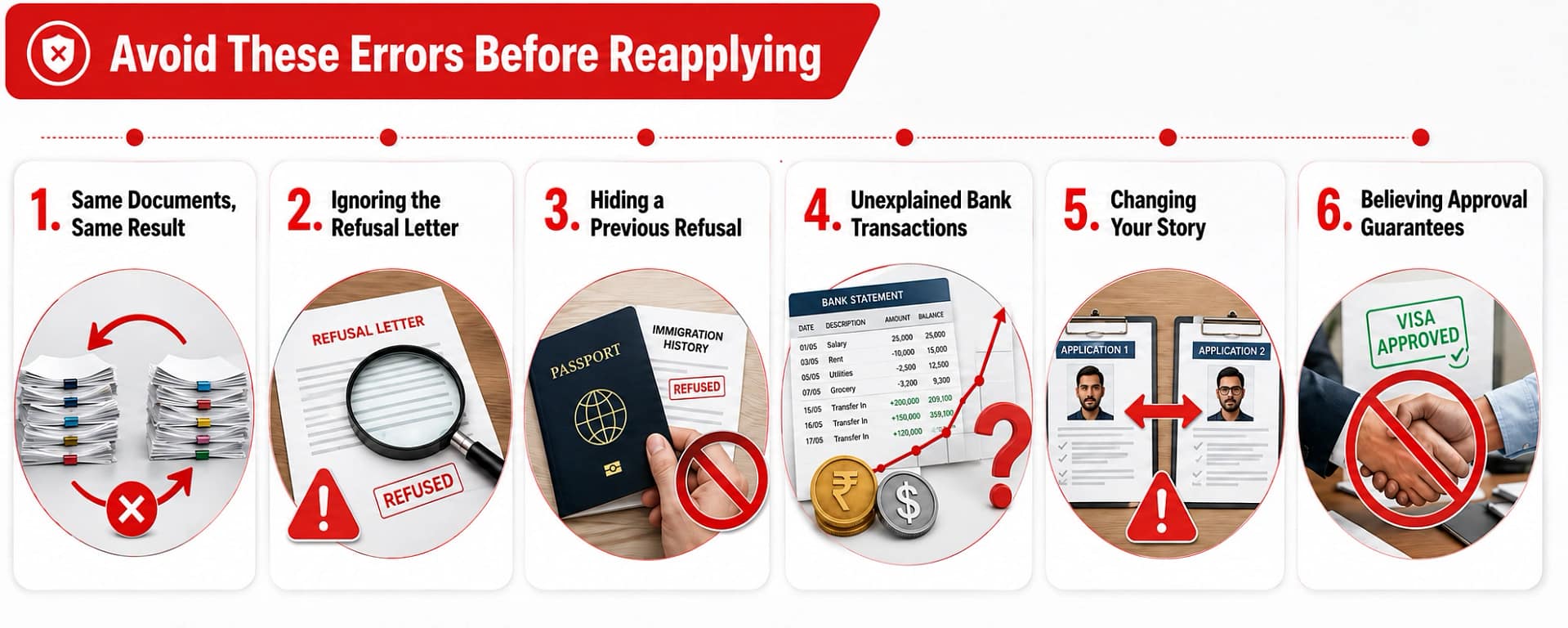
- Reapplying Immediately With the Same Documents
This is one of the biggest mistakes. If the evidence has not changed, the officer may reach the same conclusion.
- Ignoring the Refusal Letter
Generic online advice cannot replace the reasons stated in your own decision.
- Hiding the Previous Refusal
If an application asks about previous refusals, answer truthfully. Never attempt to conceal immigration history.
- Submitting Unexplained Financial Transactions
A large balance alone does not automatically demonstrate genuine financial capacity. Your documents should present a credible financial picture.
- Changing Your Story to Look Stronger
Your new application must remain consistent with previous applications unless there is a genuine change that can be explained.
- Assuming an Agent Can Guarantee Approval
No representative can guarantee that a visa will be approved. Eg, Canada’s immigration authority specifically warns that hiring a representative does not increase the chance of approval or change a previous decision by itself.
Visa Reapplication Checklist
Before reapplying after a visa refusal, review this checklist:
- Read the complete refusal letter.
- Identify every refusal reason.
- Check whether appeal or review rights exist.
- Confirm relevant deadlines.
- Compare the refusal reason against official visa requirements.
- Gather stronger supporting evidence.
- Correct genuine errors or inconsistencies.
- Explain material changes clearly.
- Review your forms against supporting documents.
- Submit only when the application genuinely addresses the earlier concerns.
Need Help After a Visa Rejection?
A visa refusal doesn’t always mean the end of your plans. JR Immigration Consultants can help you understand the refusal reasons, identify gaps in your application, and prepare a stronger reapplication based on your circumstances.
Get professional immigration guidance from JR Immigration Consultants before you reapply.
Conclusion
A visa rejection does not necessarily end your travel plans, but the next application should not be rushed.
Start with the refusal letter. Understand exactly why the application failed, determine whether reapplication, review, or appeal is appropriate, and strengthen the evidence that directly relates to the problem.
Most importantly, use the official immigration authority for your destination country as your primary source. Visa rules, fees, review rights, documentation requirements, and procedures can change.
A well-prepared visa reapplication is not about submitting more documents. It is about submitting the right evidence, consistently and honestly, to address the reason your previous application was refused.