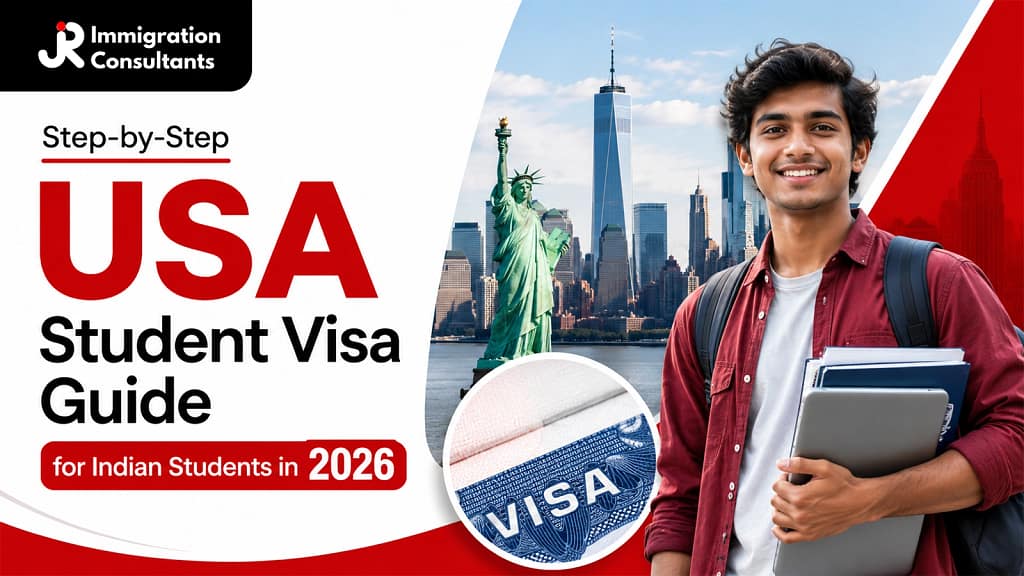
Have you been dreaming of studying in the USA in 2026? You are not alone. Thousands of students from India leave each year with hopes to get better education and have bright future. USA offers one of the best educational facilities worldwide. Great research, globally recognized degrees, and a culture that welcomes international students from everywhere.
But before you book your flight there is one important thing you need to sort out first — your student visa. Without the right visa you simply cannot study there legally.
In this guide we cover everything you need to know about the USA student visa process for Indians in 2026, including eligibility requirements, required documents, application steps, and important U.S. Visa Interview Rules.
Understanding the USA Student Visa
A USA student visa is simply an official document that lets international students enter America and study at an approved school or university. The F-1 visa is the most commonly used one covering academic programs at universities, colleges, and language institutions. Before applying you need to secure admission from a SEVP approved school and get your Form I-20 ready. This visa allows you to study legally while staying within US immigration guidelines.
USA Student Visa Eligibility Criteria in 2026
| Eligibility Criteria | Undergraduate Students (Bachelor’s) | Graduate Students (Master’s / Ph.D.) |
| 1. Institutional Approval | Must have an official, active Form I-20 from a SEVP-certified US college or university. | Must have an official, active Form I-20 from a SEVP-certified US graduate school. |
| 2. Educational Background | Must have completed 12 years of formal schooling (Class 12th Board Exams). | Must hold a recognized Bachelor’s degree (3 or 4-year program) from an accredited university. |
| 3. Language Proficiency | Proof of English skills via TOEFL, IELTS, or Duolingo (unless waived by the university). | Higher score expectations for TOEFL/IELTS, especially if applying for Teaching Assistantships. |
| 4. Standardized Tests | SAT or ACT scores (if required by your chosen university’s policies). | GRE or GMAT scores (if mandatory for your specific graduate department). |
| 5. Financial Capability | Prove you have enough funds for the first year of studies and living expenses — mostly via parents. | Must show liquid funds for the first year (can include self-funding, loans, or university TA/RA stipends). |
| 6. Non-Immigrant Intent | Must prove clear intent to return to India after graduation (family ties, property, or career goals). | Must prove intent to return to India (strong focus on how the advanced specialization applies to the Indian market). |
Note for 2026 Applicants: Ensure the funding amounts listed on your Form I-20 match your liquid bank balance or loan sanction letters perfectly before booking your interview slots.
Step-by-Step USA Student Visa Process for Indians
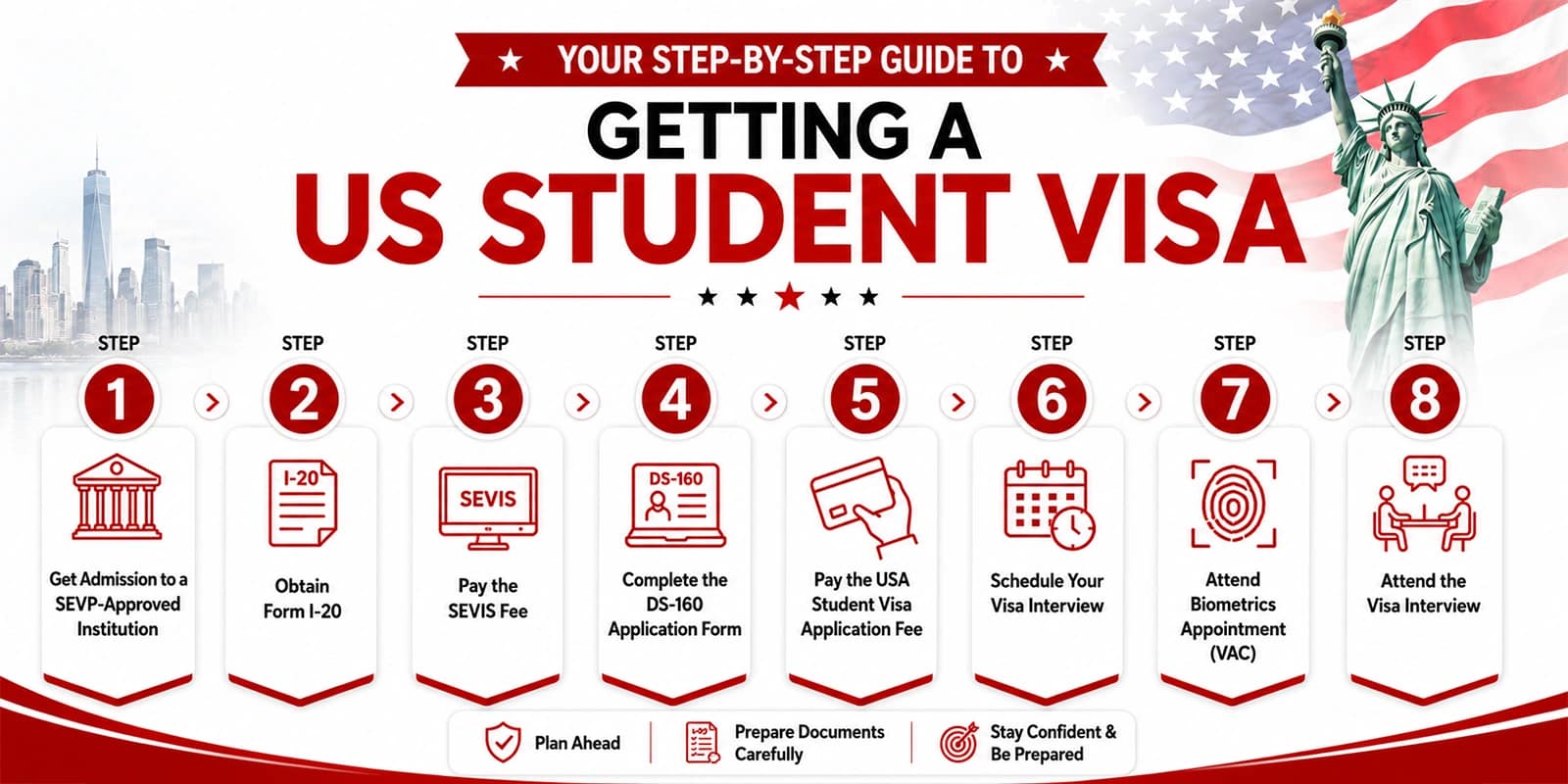
Step 1: Get Admission to a SEVP-Approved Institution
The first and most step is getting admission from a SEVP approved university or college. Only these institutions are authorized to take in international students. Once you are selected the university gives you an official admission letter and that is your confirmation to start the visa process.
Step 2: Obtain Form I-20
After admission comes Form I-20 which your university will provide. This is very important document for your F-1 visa application. It carries all your course details, program length, and financial requirements. Without this form you simply cannot schedule your visa interview or move ahead.
Step 3: Pay the SEVIS Fee
SEVIS stands for Student and Exchange Visitor Information System. It is basically a system that tracks international students in the USA. You need to pay the SEVIS I-901 fee before applying for your visa. After payment a receipt is generated which is required throughout your visa process.
Step 4: Complete the DS-160 Application Form
DS-160 is the official online application form for your USA visa. Be honest and careful when filling in your personal, academic, and travel details. One wrong entry can cause big problems so read everything twice before you hit submit.
Step 5: Pay the USA Student Visa Application Fee
The Machine Readable Visa (MRV) fee is a mandatory payment you need to make before you can book your visa interview. In India you can pay it through authorized banks or online payment methods. Once paid keep the receipt handy as it is required for scheduling your appointment.
Step 6: Schedule Your Visa Interview
After payment go to the US visa appointment portal and create your profile. Then book your Biometrics and Embassy interview from there. Always double check the location and date you select to make sure everything moves ahead without any delays.
Step 7: Attend Biometrics Appointment (VAC)
At the Visa Application Center they will take your fingerprints and photographs to verify your identity. Carry your passport and appointment confirmation with you. You cannot skip this step before going to your embassy interview.
Step 8: Attend the Visa Interview
Visa interview at the Embassy or Consulate is the final step. The visa officer reviews your academic plans, financial viability, and plans for your immigration to India. The chances of approval are improved by a great deal when it comes to clear communication, great documentation, and confidence.
Many students choose to hire USA visa consultants before their interview to receive professional guidance on documentation, financial proof, and interview preparation, helping them avoid common mistakes during the application process.
Documents Required for a USA Student Visa
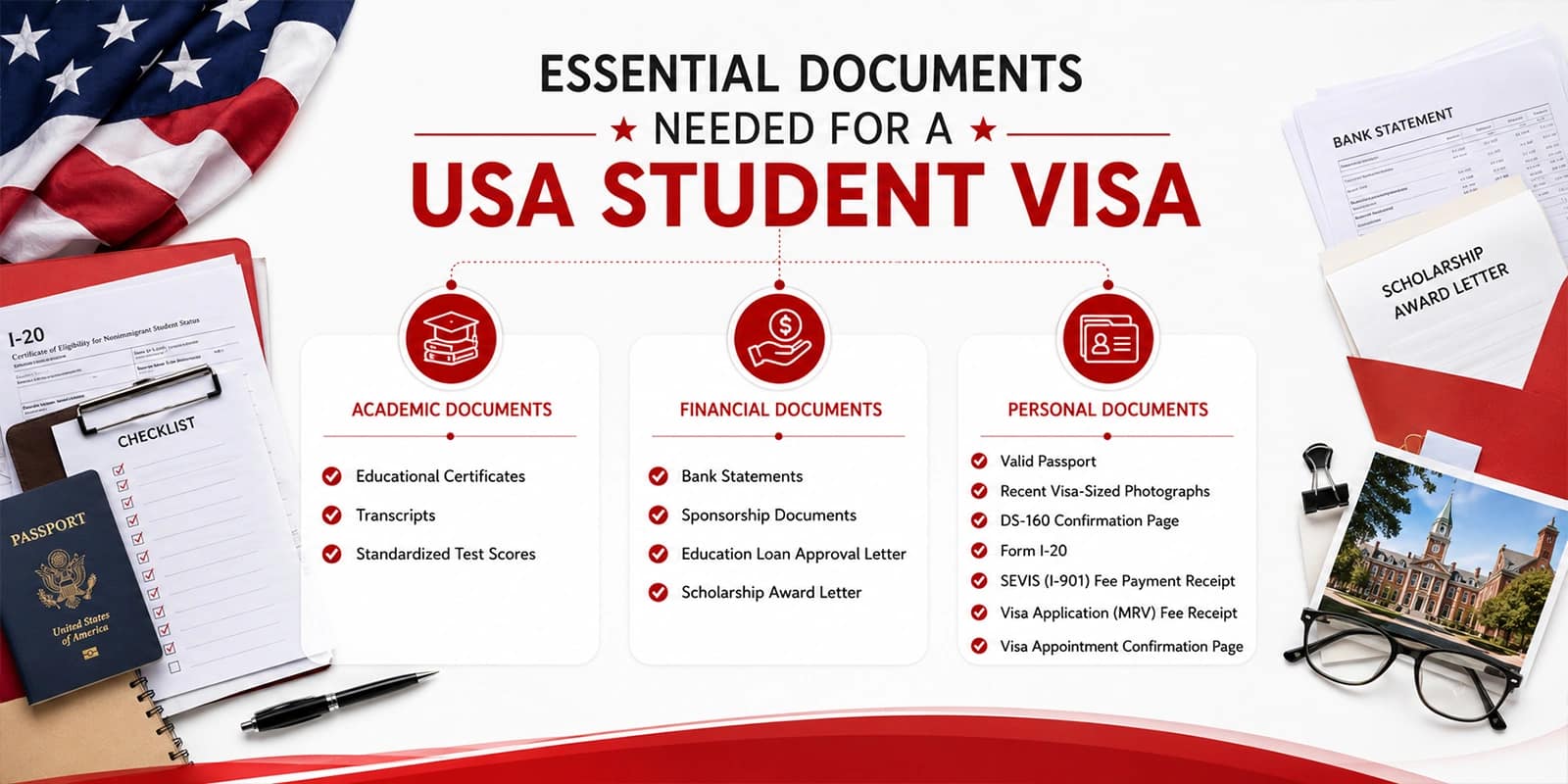
Getting the right documents is among the top considerations when applying for USA student visa. For Indian students, it is necessary to make sure that their documentation is updated and aligned the standards of the American Embassy.
Given below is a detailed list of all the documents that one will require while applying for an F-1 visa in the year 2026:
Academic Documents
Academic documents are necessary to provide evidence regarding the applicant’s education and suitability for the course at a US university/college.
Educational Certificates
- Undergraduates: Bring your official Class 10th and 12th Board Passing Certificates.
- Graduates: Bring your Bachelor’s Degree or a Provisional Degree Certificate (PDC).
Transcripts
- Undergraduates: Consolidated or year-wise report cards from Classes 9, 10, 11, and 12.
- Graduates: Official university transcripts or your full set of individual semester-wise mark sheets.
Standardized Test Scores
- Bring your official exam scorecards for SAT, ACT, GRE, or GMAT (whichever was required for your admission).
- Include your English language proficiency test scores like TOEFL, IELTS, or Duolingo.
Financial Documents
Financial proof is mandatory to show that you can cover your tuition fees, living expenses, and other costs while studying in the United States without financial difficulty.
Bank Statements
- Must show account transaction history for the last 4–6 months.
- Funds must be liquid (e.g., savings accounts or easily withdrawable fixed deposits).
Sponsorship Documents
- Required if you are funded by parents, guardians, or close relatives.
- Include a signed Affidavit of Support along with the sponsor’s Income Tax Returns (ITRs).
Education Loan Approval Letter
- Must be an official sanction letter from a recognized public/private bank or NBFC.
- The letter must state that the loan is fully approved or unconditional.
Scholarship Award Letter
- Bring the official institutional funding or assistantship letter, if applicable.
Note: Ensure any tuition waivers are directly matching your Form I-20.
Personal Documents
Personal and visa-related documents are required to complete your application, schedule appointments, and attend your visa interview at the US Embassy or Consulate.
Valid Passport
- Must be valid for at least 6 months beyond your US arrival date.
- Must have at least 2 blank pages.
- Note: Bring all old, expired passports if you have past travel history.
Recent Visa-Sized Photographs
- Must be exactly 2×2 inches (51 x 51 mm) with a plain white background.
- Taken within the last 6 months showing your full face with neutral expressions.
- Do not wear glasses or uniforms in the photo.
DS-160 Confirmation Page
- Must show a clear, scannable confirmation barcode.
Form I-20
- Issued by an SEVP-approved university and physically signed by you in ink.
SEVIS (I-901) Fee Payment Receipt
- Official printed payment confirmation ($350 USD for F-1).
Visa Application (MRV) Fee Receipt
- Proof of your $185 USD processing payment.
Visa Appointment Confirmation Page
- Showing dates for both your VAC (Biometrics) and Consular Interview.
Conclusion
Finally, obtaining a visa for studying in the United States of America is one of the last steps and at the same time the main one towards realizing your dream of becoming a successful student in one of the best educational systems. With correct preparation and a thorough knowledge of all processes related to a student visa in 2026, Indian students will be able to increase their chances of a positive outcome many times. Each stage of the procedure from choosing a good university to a visa interview itself is necessary and equally important.