
Applying for an Australian student visa in 2026 isn’t just about filling out a form—it’s about meeting strict requirements, proving genuine intent, and avoiding costly mistakes that can delay or even reject your application. Every year, thousands of students miss out due to incomplete documents, financial proof issues, or a misunderstanding of eligibility criteria.
Before you hit “apply,” it’s crucial to understand exactly what the Australian government expects—from academic qualifications and English proficiency to Genuine Student (GS) requirements and financial capacity. This guide breaks down everything you need to know so you can apply with confidence, avoid common pitfalls, and improve your chances of visa approval the first time.
Why Study in Australia

Australia is in high demand when it comes to the best study destinations for foreign students. Universities such as the University of Melbourne, the Australian National University, and the University of Sydney regularly rank among the top in the world.
The advantages of studying in Australia include:
- Degrees that are recognised worldwide
- Work opportunities for Graduates
- Multicultural Environment
- Good standard of living
- Good job market
- Secure and student-friendly cities
But you need to apply for your own Australian Student Visa (Subclass 500) before enjoying these benefits.
What Is the Australian Student Visa (Subclass 500)?
The student visa (subclass 500) grants international students the following rights:
- Apply for a full-time CRICOS-registered course of study
- Remain in Australia for the period of the course
- Work for up to a maximum of permitted hours while they are studying
- Add eligible dependants
The visa is normally issued for up to 5 years, depending on the length of the course.
Are You Really Visa-Ready? Check These Essentials
Before applying, ensure you meet the following key requirements.
1. Confirmation of Enrolment (CoE)
You must have a Confirmation of Enrolment (CoE) issued by an Australian education provider to apply. Upon receiving your offer letter:
- Submit your deposit for tuition.
- Accept the offer in writing.
- Get your CoE
Your course must be CRICOS-registered (Commonwealth Register of Institutions and Courses for Overseas Students).
2. GSR: Genuine Student Requirement
The GS (Genuine Student) requirement is a new requirement replacing the GTE (Genuine Temporary Entrant) requirement. You need to prove:
- Genuine intention to study
- Clear academic progression
- Defined career goals
- Intent to obey visa conditions
Your Statement of Purpose (SOP) plays a critical role here.
3. English Language Proficiency
You must prove your English proficiency through accepted tests, such as:
- IELTS
- PTE Academic
- TOEFL iBT
Minimum score requirements depend on:
- Course level
- University requirements
- Country risk level
Always check your institution’s specific requirements.
4. Financial Requirements for Australian Student Visa
Proof of funds is one of the key factors in visa approval. You need to show that you have the financial means to:
- Tuition fees (1 year)
- Living expenses
- Travel costs
- OSHC – Overseas Student Health Cover
The minimum amount that students are required to have for living expenses is set by the government of Australia every year. The money should be real, traceable, and all the needed documentation should be attached.
Acceptable Financial Proof:
- Bank statements
- Education loan sanction letter
- Fixed deposits
- Income tax returns of the sponsor
Insufficient or unclear financial documents are among the top reasons for visa refusal.
5. Overseas Student Health Cover (OSHC)
OSHC is mandatory for all international students. It covers:
- Doctor visits
- Hospital treatment
- Ambulance services
- Limited medicines
You must purchase OSHC before lodging your visa application.
Common Mistakes That Lead to Visa Rejection
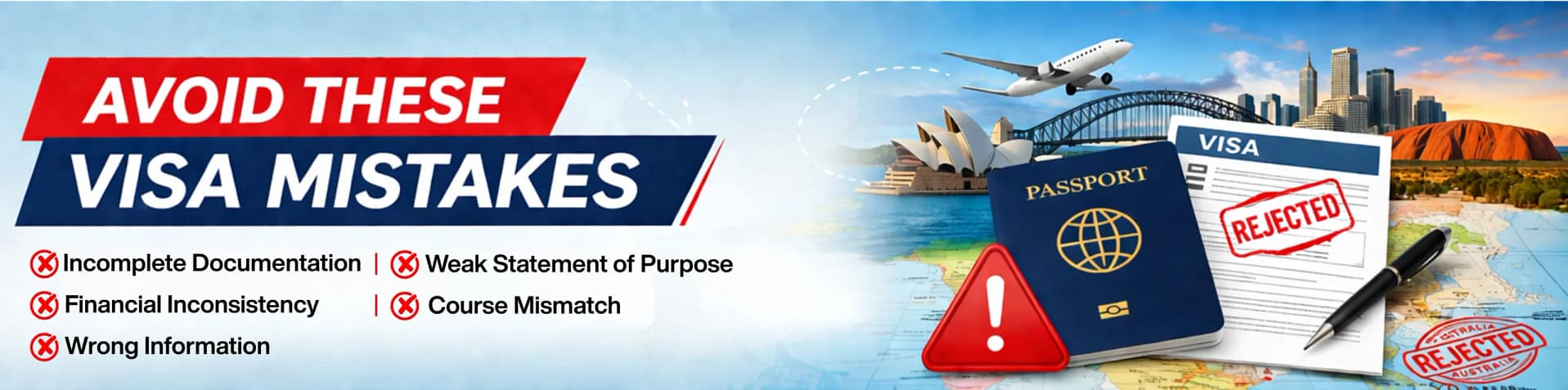
The applicants with good academic records are also getting rejections due to mistakes.
- Incomplete Documentation: Lack of bank statements or wrong documents may result in a delay.
- Weak Statement of Purpose: A vague SOP career-wise creates confusion and doubts.
- Financial Inconsistency: Big deposits in bank accounts without explanations are red flags.
- Course Mismatch: Selecting a course that is not in line with your previous education, and no reason is given.
- Wrong Information: Even minor discrepancies can undermine the credibility.
Read More: The New U.S. Visa Interview Rule 2025: Key Updates You Must Know
How Long Does It Take to Get an Australian Student Visa?
There is no fixed processing time for an Australian Student Visa (Subclass 500). It depends on a number of factors, and knowing about them can help you better prepare for what to expect and avoid the panic at the end.
1. Course Sector
Various aspects of the education sector are evaluated at varying rates.
- Higher Education (Bachelor’s, Master’s)
- Vocational Education and Training (VET)
- English Language Intensive Courses (ELICOS)
Indeed, some sectors are subject to more scrutiny because of historical risk levels, which may affect timelines.
2. Completeness & Accuracy of Documents
Incomplete or contradictory paperwork is the #1 cause of delays. Applications with:
- Clear financial evidence
- Valid English test results
- An SOP that is well-organised
- Valid CoE and OSHC
have a quicker processing time, in general and sometimes without further enquiries.
3. Peak Intake Season
Visa offices are busiest before major intakes:
- February (Semester 1)
- July (Semester 2)
Applications submitted close to these periods may take longer due to higher volume.
4. Country Risk Level & Individual Profile
Applicants are assessed based on nationality, academic background, and travel history. Strong profiles with consistent academics and genuine study intent tend to move faster.
Essential Tips to Increase the Probability of Visa Approval
✔ Apply early on: Don’t wait until the last minute to submit your application before the deadline.
✔ Clean financial records: Don’t make any sudden large deposits before visa filing.
✔ Pick the right course: The course you choose has to be related to what you’ve done in past and what you want to do in future.
✔ Write a Strong SOP
Tell us clearly:
- Why this course?
- Why Australia?
- Why this university?
- Career plans after completion?
✔ Seek Professional Guidance
A seasoned education consultant can assist in minimising mistakes.
Read More: Questions to Ask a Visa Consultation Company in Bangalore Before
Why Indian Students Are Rejected (And How to Change That)
Visa scrutiny has been on the rise in recent years. The authorities scrutinise applications to weed out fakes and students who are not genuine. To avoid rejection:
- Submit the financial documents of the loan and income, etc.
- Maintain academic consistency.
- Avoid fake documents.
- Be truthful in your application.
Remember, one denial could affect future applications.
Conclusion
Applying for an Australian Student Visa is not just paperwork – it’s you showing up as a truthful, authentic, and well-thought-out person. Being properly prepared can mean the difference between processing and holding.
The fact that Australia has a world-class education system and a global career perspective is undeniable, but it all starts with a strong visa application supported by the right guidance.
At JR Immigration Consultants assist you to Apply Smart – Not Hard. From choosing courses and drafting your Statement of Purpose (SOP) for university admission to arranging financial documents or managing your visa application, our specialists bring you every ounce of their expertise to ensure compliance with immigration rules.
Do today prepare right, and tomorrow the world shall be your home.